
NASA Reveals Near-Earth Asteroid 1998 SH2 Is an Active Comet - Techgenyz
Introduction
The National Aeronautics and Space Administration, widely recognized as NASA, has formally revealed a major update regarding the space object known as 1998 SH2. Initially categorized by astronomers as a standard Near-Earth Asteroid, the object has now been reclassified following new observations. According to findings reported by the scientific community, 1998 SH2 exhibits active cometary behavior rather than remaining classified as an inactive, solid body. This significant transition changes the scientific understanding of the object's physical nature and its behavior as it travels through space.
The discovery marks a notable shift in the ongoing monitoring of objects residing in or passing through the near-Earth space environment. By identifying clear evidence of cometary activity, NASA has demonstrated that 1998 SH2 belongs to the category of active comets rather than traditional asteroids. This reclassification highlights the dynamic nature of deep-space monitoring, where space bodies previously thought to be inert space rocks are found to possess active processes typical of comets.
Background
The object designated as 1998 SH2 has been a subject of astronomical observation since its initial cataloging, carrying an alphanumeric designation that reflects its place within astronomical tracking systems. Prior to recent revelations, the object was formally categorized within astronomical databases as a Near-Earth Asteroid. Under this previous classification, 1998 SH2 was understood to be a standard, inactive asteroid traversing an orbit in the relative vicinity of Earth.
Information regarding this reclassification was published by the media outlet Techgenyz and subsequently aggregated and retrieved through Google News India. The source material detailing this transition focuses primarily on the core scientific shift announced by NASA. While historical records track the object under its original asteroid designation, the updated data provided by NASA overrides the earlier assumption that 1998 SH2 was merely a dormant piece of space debris.
Throughout its recorded history in scientific catalogs, 1998 SH2 remained identified as an asteroid until observational evidence confirmed otherwise. The formal categorization of celestial bodies near Earth depends heavily on observable traits, and for an extended period, 1998 SH2 satisfied the criteria for an asteroid classification. The background of this object underscores how astronomical designations can evolve when updated findings reveal previously unseen behaviors in celestial objects.
Latest Developments
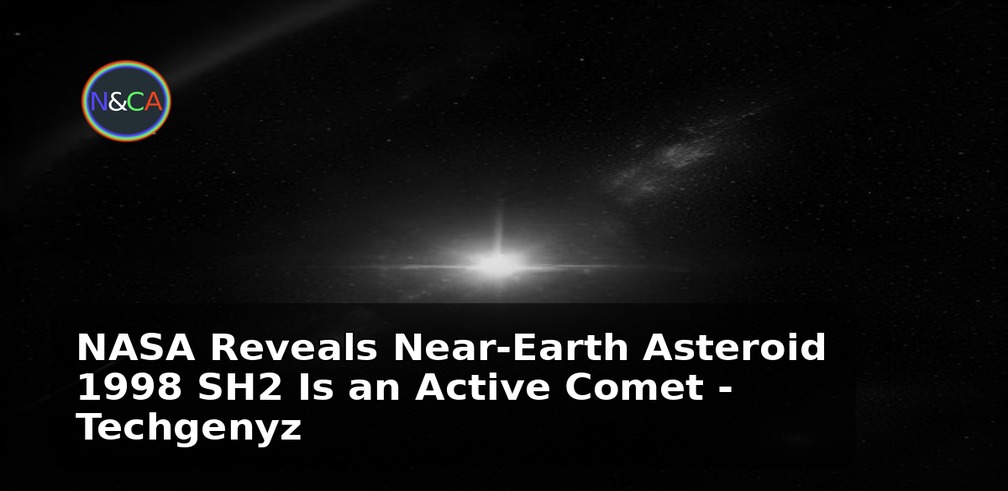
The primary development surrounding 1998 SH2 is the definitive announcement by NASA that the object is displaying active cometary behavior. Unlike standard asteroids, which are characterized as inactive bodies without observable gas or dust activity, an active comet demonstrates distinct physical outputs. NASA's updated evaluation confirms that 1998 SH2 exhibits these active features, prompting its official reclassification from a Near-Earth Asteroid to an active comet.
The National Aeronautics and Space Administration is the sole scientific agency identified in the report as responsible for making this scientific determination. The agency's findings confirm that 1998 SH2 can no longer be viewed strictly as a static asteroid. Instead, its behavior aligns directly with cometary processes, distinguishing it from the vast majority of ordinary near-Earth asteroids currently monitored by space agencies.
While the announcement clearly establishes the active nature of 1998 SH2, specific technical details regarding the mechanism of its activity remain omitted from the available source material. Similarly, precise physical dimensions, exact orbital parameters, distance from Earth, and chemical composition are not detailed in the published reporting. Despite these missing parameters, the central development remains clear: NASA has verified that 1998 SH2 is actively behaving as a comet.
Key Facts
A summary of the verified facts and parameters surrounding the reclassification of 1998 SH2 includes the following documented details:
• Reporting Organization: The National Aeronautics and Space Administration, known as NASA, identified and announced the new classification.
• Object Designation: The space object is officially identified by the alphanumeric reference name 1998 SH2.
• Previous Classification: The celestial body was previously categorized and tracked within astronomical databases as a Near-Earth Asteroid.
• Updated Classification: The object has been formally reclassified as an active comet due to newly confirmed cometary behavior.
• Observed Behavior: 1998 SH2 displays active cometary behavior rather than remaining categorized strictly as an inactive asteroid.
• Distribution Sources: The news report was published by the media outlet Techgenyz and retrieved via Google News India.
• Unspecified Astronomical Parameters: Details concerning the object's physical dimensions, composition, exact orbit, distance from Earth, and mechanisms of activity are omitted from the source.
• Unspecified Chronological Data: Exact dates detailing when NASA made the announcement, when cometary activity was detected, or when the article was published are omitted.
• Unspecified Personnel Data: No individual lead astronomers, researchers, NASA spokespersons, or article authors are named in the provided material.
Conclusion
The reclassification of 1998 SH2 from a Near-Earth Asteroid to an active comet represents an important update in planetary science and celestial object tracking. The core significance of this story lies in the formal redefinition of a space object's nature based on direct scientific observations provided by NASA. Reclassifying an object from a dormant asteroid to an active comet alters how the space community views 1998 SH2 within the catalog of near-Earth objects.
This news highlights the ongoing efforts of organizations like NASA to continuously assess and re-evaluate space objects near Earth. As observational capabilities and analytical methods continue to monitor the solar system, objects long thought to be static asteroids can reveal cometary activity, leading to definitive updates in scientific records.
Although specific orbital risks, potential Earth proximity hazards, future observation targets, or broader research implications were omitted from the source text, the fundamental shift in 1998 SH2's status stands as a clear record of NASA's crucial role in updating our understanding of celestial bodies within our solar system.
- © news & current affairs
- Design: N&CA